
Replacing a machined aluminium part with PA-CF – when it pays off
Brackets, angles, adapter plates and grippers are often milled from aluminium because that is how it has always been done. Carbon-fibre-reinforced polyamide is an alternative for many of these parts – not for all. Here is how to tell.
Does it really have to be aluminium?
A single milled part involves CAM programming, setup and often outsourcing. For single parts and small quantities these fixed costs determine the price – and the waiting time determines when the machine runs again.
Many brackets and fixtures are made of aluminium because it is the familiar material, not because the load requires it.
- Single part or small batch with high setup effort for milling
- Complex geometry with pockets, undercuts or channels
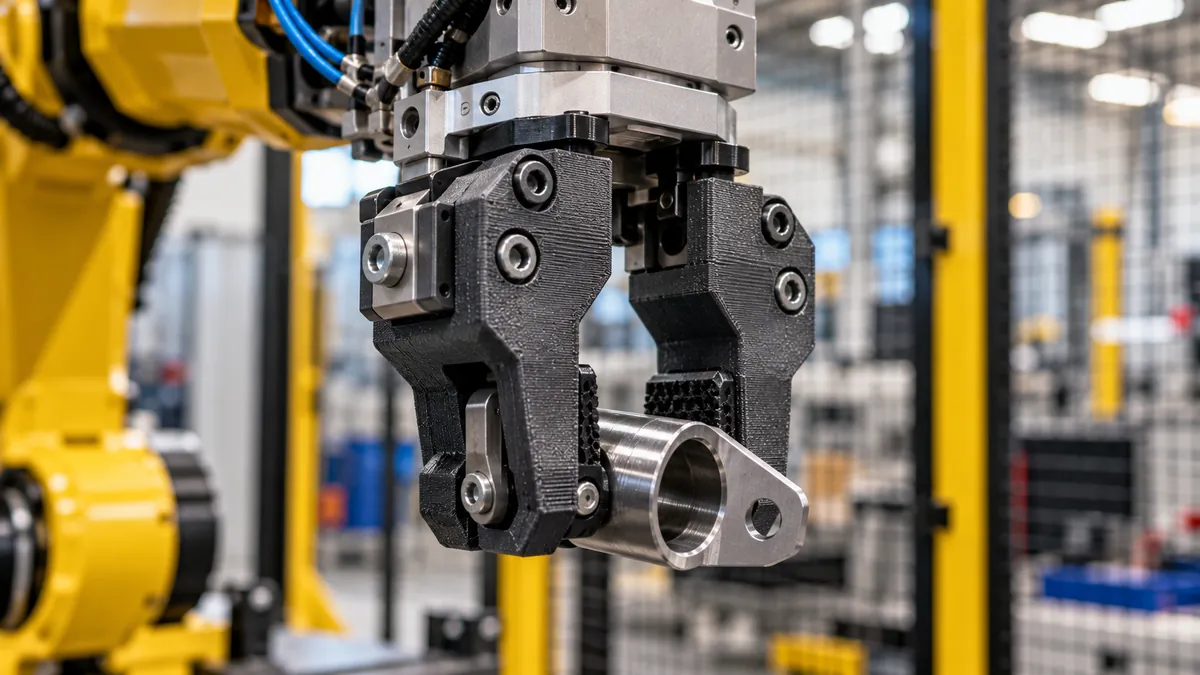
- Moving mass on a robot or linear axis should be reduced
- Lead time of the milled part delays commissioning or maintenance
Check against the load case, not the material name
We assess the part from a design perspective: forces and load direction, operating temperature, tolerances, quantity. For many fixtures and grippers PA-CF is an alternative to aluminium; the specific stiffness is given in the manufacturer datasheet. The part is adapted to the process and oriented according to the main load direction.
The switch typically pays off when several of the following points apply:
- Single part or small batch of up to 500 pieces
- Geometry that needs many setups or special tools when milled
- Operating temperature well below the heat deflection temperature in the datasheet
- Tolerances in the range of typically ±0.2 mm; tighter dimensions only on a few functional surfaces
- Lower weight brings an advantage, for example on moving axes
- Short lead time matters: express 2–3 working days, standard 5–7 working days
Suitable materials
Carbon and glass fibre reinforced materials for parts that used to be milled. All values according to the manufacturer datasheet, measured in the printing plane.
PA-CF
The standard for load-bearing brackets, grippers and fixtures previously milled from aluminium.
- Heat deflection
- ~175–180 °C (HDT/A)
- Strength
- ~80–110 MPa (ISO 527)
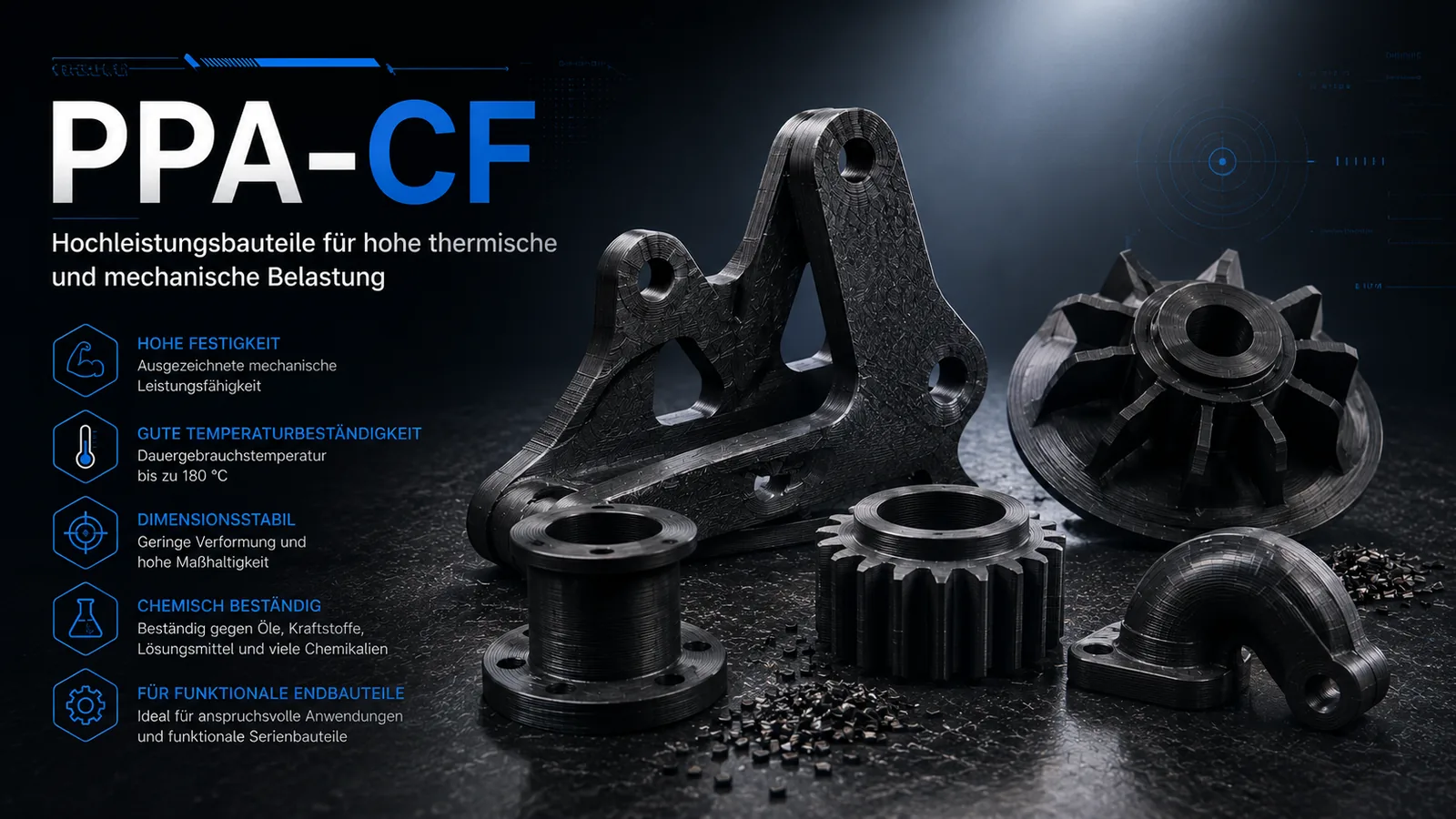
PPA-CF
When stiffness counts: 9,860 MPa flexural modulus and 1.25 g/cm³ density according to the manufacturer datasheet. Only 57 MPa tensile strength in Z.
- Heat deflection
- 227 °C (HDT/B, 0,45 MPa) / 196 °C (HDT/A, 1,8 MPa)
- Strength
- 168 ± 4 MPa (X-Y, ISO 527)
PA6-GF
For parts with impact and vibration. Glass fibre instead of carbon.
- Heat deflection
- ~182 °C (HDT/A)
- Strength
- ~120 MPa (ISO 527)
PPS-CF
For chemical contact and humid environments. Strongly anisotropic according to the manufacturer datasheet: only 24 MPa in Z.
- Heat deflection
- 264 °C (HDT/B, 0.45 MPa) / 235 °C (HDT/A, 1.8 MPa)
- Strength
- 87 ± 5 MPa (X-Y, ISO 527)
Values according to the manufacturer’s datasheet, measured in the printing plane (X-Y).
Limits of FFF
FFF is not the right process for every part. These points are checked before we quote:
- Tolerances: typically ±0.2 mm; general tolerances to DIN ISO 2768-m; tighter tolerances on functional surfaces by arrangement, possibly with post-machining.
- Parts are built in layers. Strength across the layers (Z) is lower than in the printing plane – we orient the part according to the main load direction.
- Permanently high load: plastics can yield under sustained load. For high static long-term loads, metal often remains the better choice.
- Load across the layers: according to the manufacturer datasheet PPA-CF reaches only about a third of its in-plane tensile strength in Z. If the part cannot be oriented suitably, the replacement is questionable.
- Tight fits without post-machining, such as bearing seats, cannot be achieved with typically ±0.2 mm.
- Carbon-fibre-reinforced materials should not be classed as electrically insulating. For insulating parts, glass-fibre variants such as PC-GF or PPS-GF are an option.
- Temperatures close to the heat deflection temperature and safety-relevant parts usually rule out the switch or require approval by the operator.
- Part size up to 500 × 500 × 500 mm, depending on the material.
From enquiry to delivered part
- 01
Enquiry
Upload STEP or STL via the calculator or send a drawing, photo or sample part description via the contact form. NDA on request before you send any data.
- 02
Design review
Every part is reviewed before production: wall thicknesses, print orientation according to the main load direction, material choice.
- 03
Quote
The calculator gives an indicative price; the binding quote follows the design review.
- 04
Production
Filament is dried before every print and stored under vacuum. For small batches and repeat orders the print parameters are documented. Express 2–3 working days, standard 5–7 working days.
- 05
Dimensional check
Dimensions are checked with a digital caliper before shipping.
- 06
Shipping
Shipped from Stuttgart – single parts or small batches of up to 500 pieces.
Frequently asked questions
Is PA-CF as strong as aluminium?
No, not across the board – and often it does not need to be. For many fixtures and grippers PA-CF is an alternative to aluminium; the specific stiffness is given in the manufacturer datasheet. Whether it is sufficient for your part depends on load case, load direction and temperature. We check this before quoting.
Can I have the drawing of the aluminium part printed 1:1?
Possible, but rarely the best solution. A milled contour is designed for milling. For printing we adapt wall thicknesses, ribs and radii and orient the part so that the main load acts in the printing plane.
How are threads and locating holes handled?
Threads are implemented with threaded inserts installed after printing. Locating holes with tighter tolerances than the typical ±0.2 mm are post-machined by arrangement.
When does milling become more economical again?
For simple, prismatic geometries and larger quantities, milling or injection moulding can be cheaper. 3D printing plays to its strengths with single parts, small batches of up to 500 pieces and complex geometry.
How does PA-CF behave with moisture?
Polyamide absorbs moisture, which is why the filament is dried before every print and stored under vacuum. For humid environments with high demands on dimensional stability, PPS-CF is an option – 0.05 % water absorption according to the manufacturer datasheet.
Have your part checked
Upload STEP or STL for an indicative price, or send a drawing, photo or description. Binding quote after the design review.