
Spare part no longer available – reproduction via 3D scan
No manufacturer, no drawing, but a sample part: we digitise it by 3D scanning, reconstruct wear and fractures in CAD and produce the spare part in a suitable material. From Stuttgart for maintenance teams in Germany, Austria and Switzerland.
The part exists – the drawing does not
A plastic part fails and the machine stops. The manufacturer has discontinued the part or no longer exists, and there are no drawings. All that is left is the old part – often broken or worn.
Measuring by hand quickly reaches its limits with free-form surfaces, radii and angled connections.
- Spare part discontinued or manufacturer no longer on the market
- No drawing and no CAD available
- Sample part worn, broken or only a fragment
- Complex free-form geometry that is hard to measure
From sample part via scan to spare part
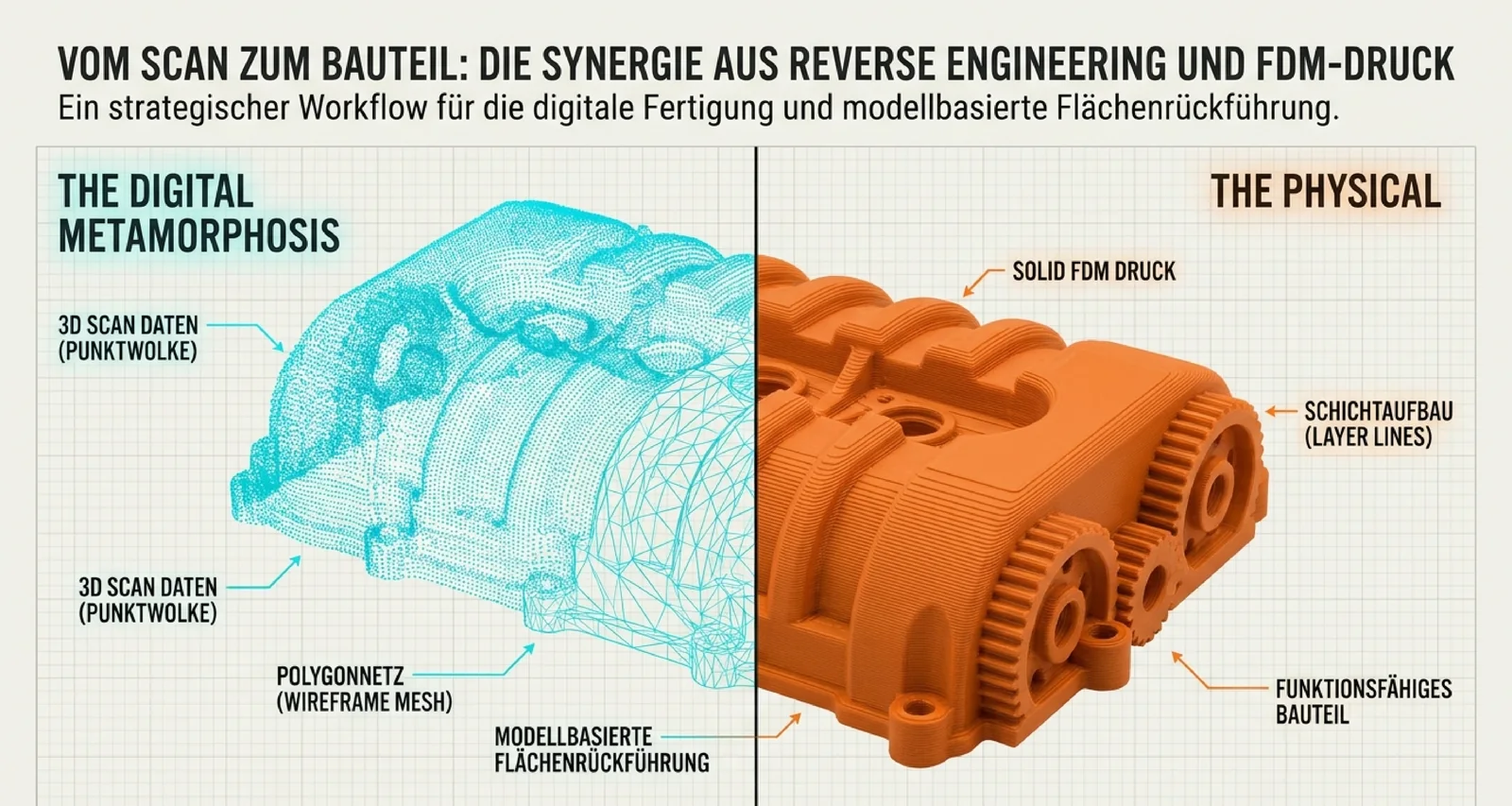
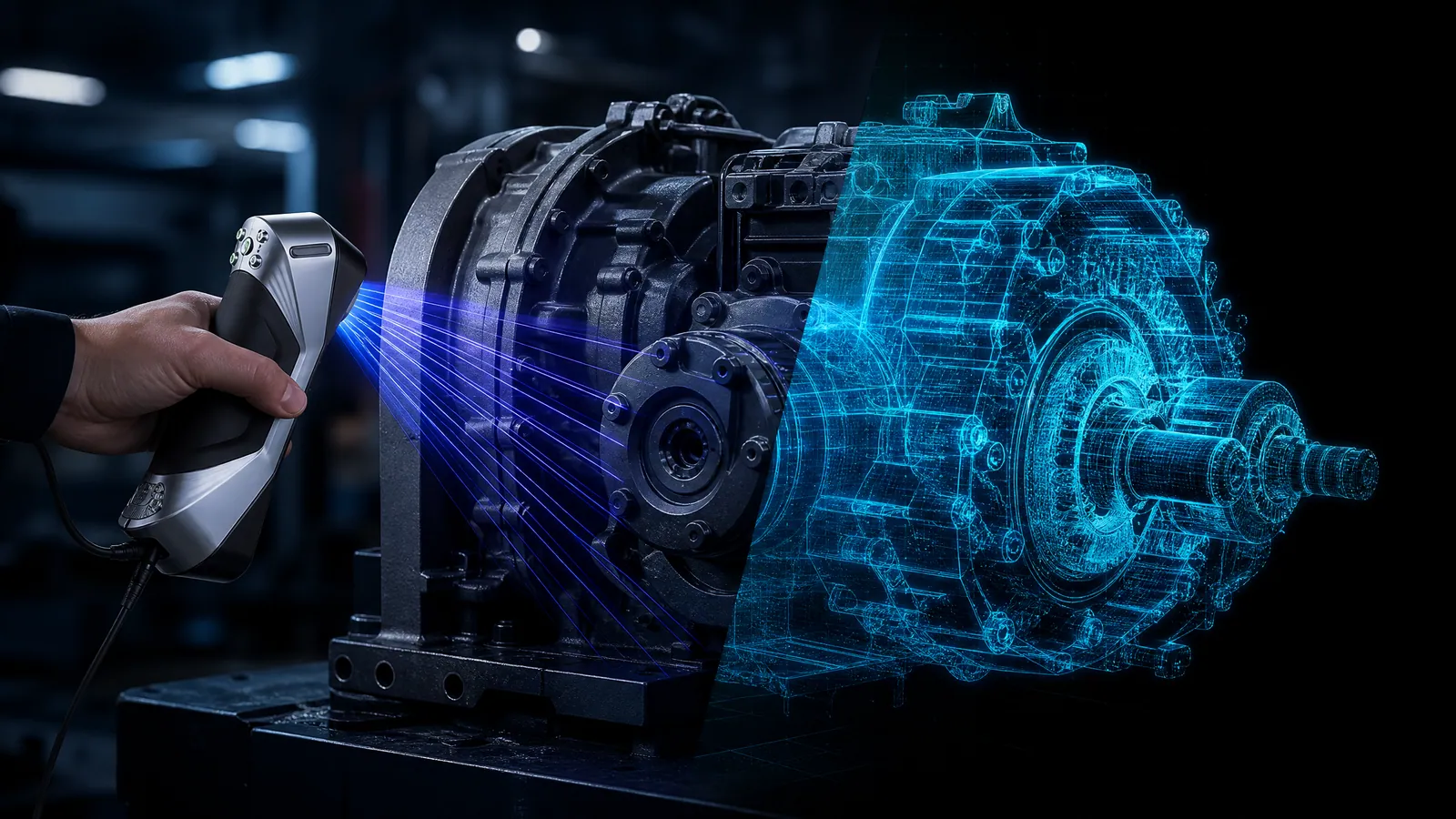
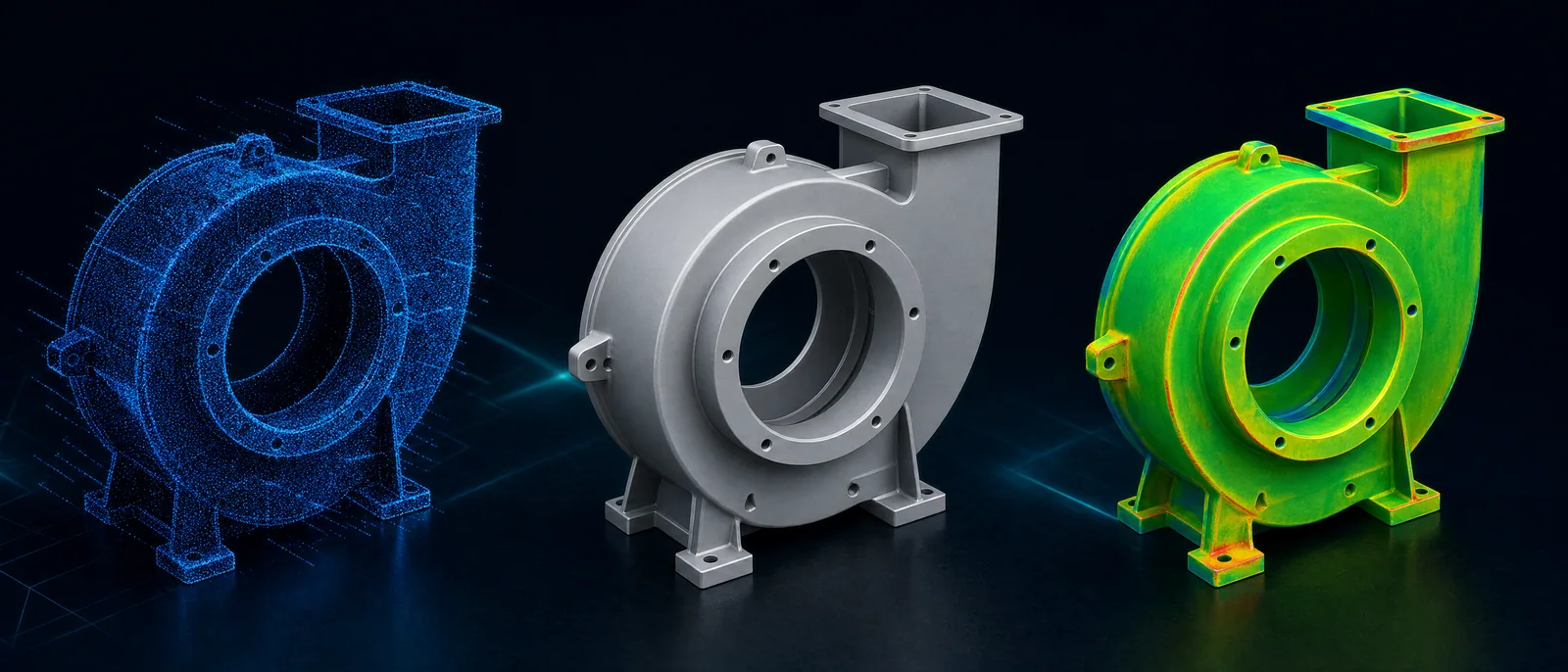
We scan the sample part at our premises or on site at yours and create a cleaned mesh. For reproduction we can convert it into a parametric CAD model (STEP) and reconstruct worn or broken areas.
The part is then design-reviewed and produced in a material that suits its use. More about the process on the page 3D-Scan & Reverse Engineering (German only).
- 3D scan of the sample part – at our site or yours
- Optional: CAD reconstruction as STEP including reconstruction of wear
- Design review before production, material chosen for the application
- Dimensional check with a digital caliper before shipping
- Documented print parameters for later reorders
Suitable materials
The original material is often unknown. We choose by load, temperature and environment. All values according to the manufacturer datasheet.
PA6-GF
For mechanically loaded spare parts with vibration, such as brackets and housing parts on machines.
- Heat deflection
- ~182 °C (HDT/A)
- Strength
- ~120 MPa (ISO 527)
PA-CF
For stiff, load-bearing spare parts in warmer machine environments.
- Heat deflection
- ~175–180 °C (HDT/A)
- Strength
- ~80–110 MPa (ISO 527)
Prusament ASA
For outdoor parts: UV and weather resistant according to the manufacturer datasheet.
- Heat deflection
- ~98–104 °C (HDT/A)
- Strength
- ~47 MPa (ISO 527)
PETG-GF
For tough covers and brackets that should yield rather than splinter.
- Heat deflection
- 94 °C (HDT A, ISO 75)
- Strength
- 56 MPa (ISO 527)
iglidur I180
For sliding parts and bushings without lubrication. No food contact according to the safety data sheet.
- Heat deflection
- 180 °C continuous operation
- Strength
- ~65 MPa
Values according to the manufacturer’s datasheet, measured in the printing plane (X-Y).
Limits of FFF
FFF is not the right process for every part. These points are checked before we quote:
- Tolerances: typically ±0.2 mm; general tolerances to DIN ISO 2768-m; tighter tolerances on functional surfaces by arrangement, possibly with post-machining.
- Parts are built in layers. Strength across the layers (Z) is lower than in the printing plane – we orient the part according to the main load direction.
- Scanning is an optical process: hidden internal geometry is not captured. Shiny, transparent or deep-black surfaces need matting spray or markers.
- The accuracy of the scanner is not automatically the accuracy of the part – surface, size and condition of the sample part play a role.
- We do not supply a first article inspection report or a metrological test certificate.
- An injection-moulded part cannot always be reproduced 1:1 in the same material. We choose an FFF material that covers the application and tell you where it falls short.
- Part size up to 500 × 500 × 500 mm, depending on the material.
From enquiry to delivered part
- 01
Enquiry
Upload STEP or STL via the calculator or send a drawing, photo or sample part description via the contact form. NDA on request before you send any data.
- 02
Design review
Every part is reviewed before production: wall thicknesses, print orientation according to the main load direction, material choice.
- 03
Quote
The calculator gives an indicative price; the binding quote follows the design review.
- 04
Production
Filament is dried before every print and stored under vacuum. For small batches and repeat orders the print parameters are documented. Express 2–3 working days, standard 5–7 working days.
- 05
Dimensional check
Dimensions are checked with a digital caliper before shipping.
- 06
Shipping
Shipped from Stuttgart – single parts or small batches of up to 500 pieces.
Frequently asked questions
I only have a broken or worn part – is that enough?
In many cases, yes. We scan the sample part and reconstruct the original geometry in CAD, for example a worn edge or a broken-off lug. Only then is the part reproduced.
Do I also get the file?
Depending on the scope ordered: the cleaned mesh as STL or OBJ, the reverse-engineered CAD model as STEP, or the printed spare part directly. Many customers take the STEP for their own documentation and have the part printed by us at the same time.
May I have a third-party spare part reproduced?
Not without further ado – parts can be protected by patents, utility models, registered designs or copyright. We only reproduce parts you are entitled to copy. Checking the IP situation is your responsibility as the client; we do not provide a legal assessment.
Do you come to the machine?
Yes. The scanner is mobile. If a part cannot be removed or shipped, we digitise it on site at your company on request.
How long does reproduction take?
The effort for scanning and CAD reconstruction depends on the part and is stated in the quote. Once the model is approved we produce in 2–3 working days (express) or 5–7 working days (standard).
Have your part checked
Upload STEP or STL for an indicative price, or send a drawing, photo or description. Binding quote after the design review.