

Plastic spare parts for legacy machines and existing systems
When a plastic part fails on a proven machine and the manufacturer no longer supplies it: reproduction from one piece based on a drawing, CAD or sample part – design-reviewed, manufactured in Stuttgart, for maintenance teams in Germany, Austria and Switzerland.
The machine runs – only the spare part is missing
Many existing systems have been running reliably for decades. What fails first are often the plastic parts: sliding blocks, rollers, guides, covers, handles, brackets.
The machine manufacturer no longer supplies the part, only with long waiting times or in quantities maintenance does not need. A new machine because of one plastic part is not an option.
- Spare part discontinued or no longer available from the manufacturer
- Long waiting time for a single part
- Minimum quantities far above actual demand
- A weak point in the original part that fails again and again
Reproduction from one piece
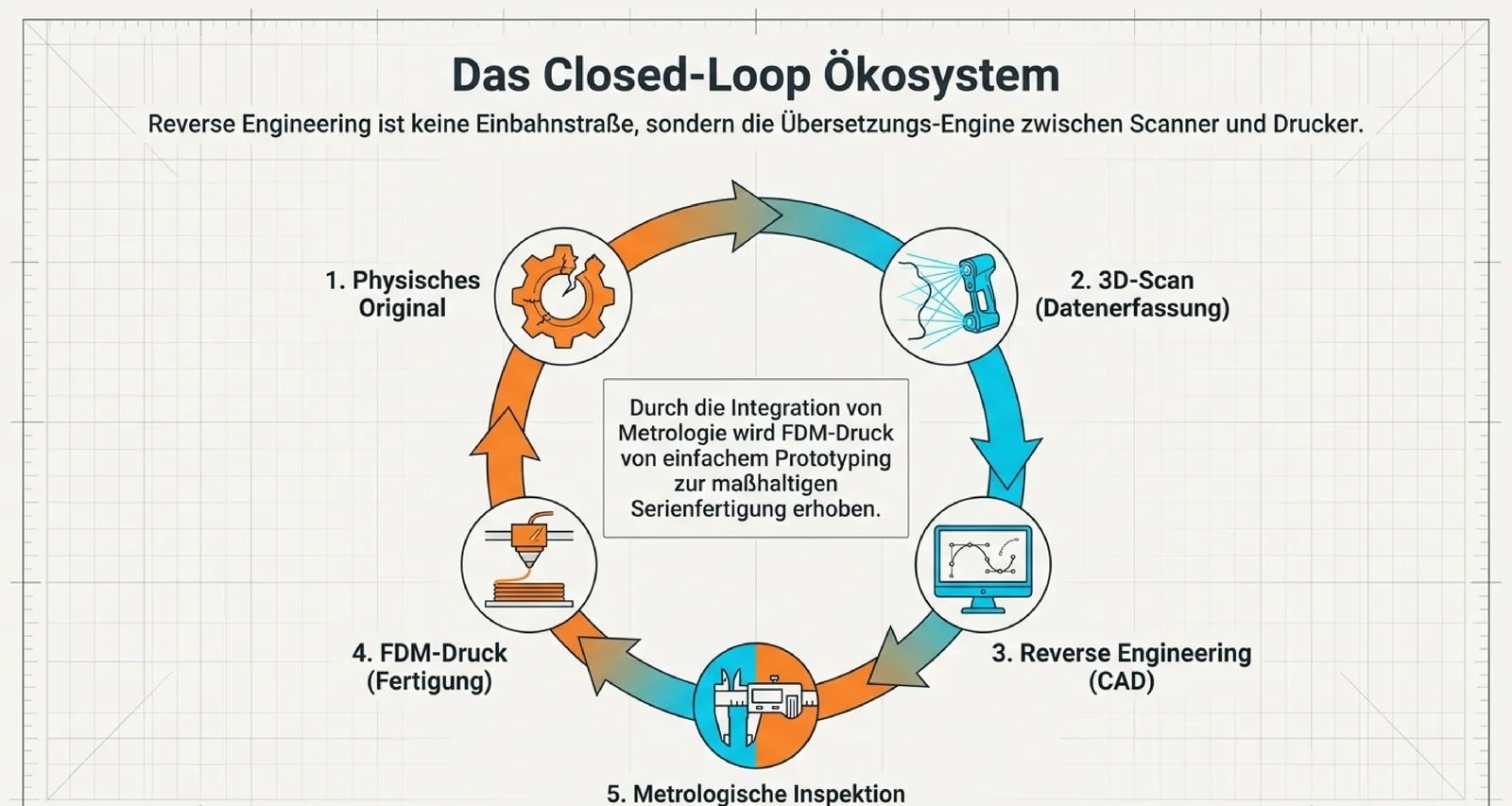
We work with what is available: a drawing, a CAD model or the old part. If documents are missing, the sample part is measured or digitised by 3D scanning and redesigned.
Every part is design-reviewed before production. We choose the material for the application – self-lubricating for sliding parts, chemically resistant for media contact, UV resistant for outdoor use. If a weak point of the original is known, it can be addressed in the design.
- No tooling, no minimum quantity – single part up to small batch of 500 pieces
- Design review of every part before production
- Filament dried before every print, stored under vacuum
- Documented print parameters for reorders
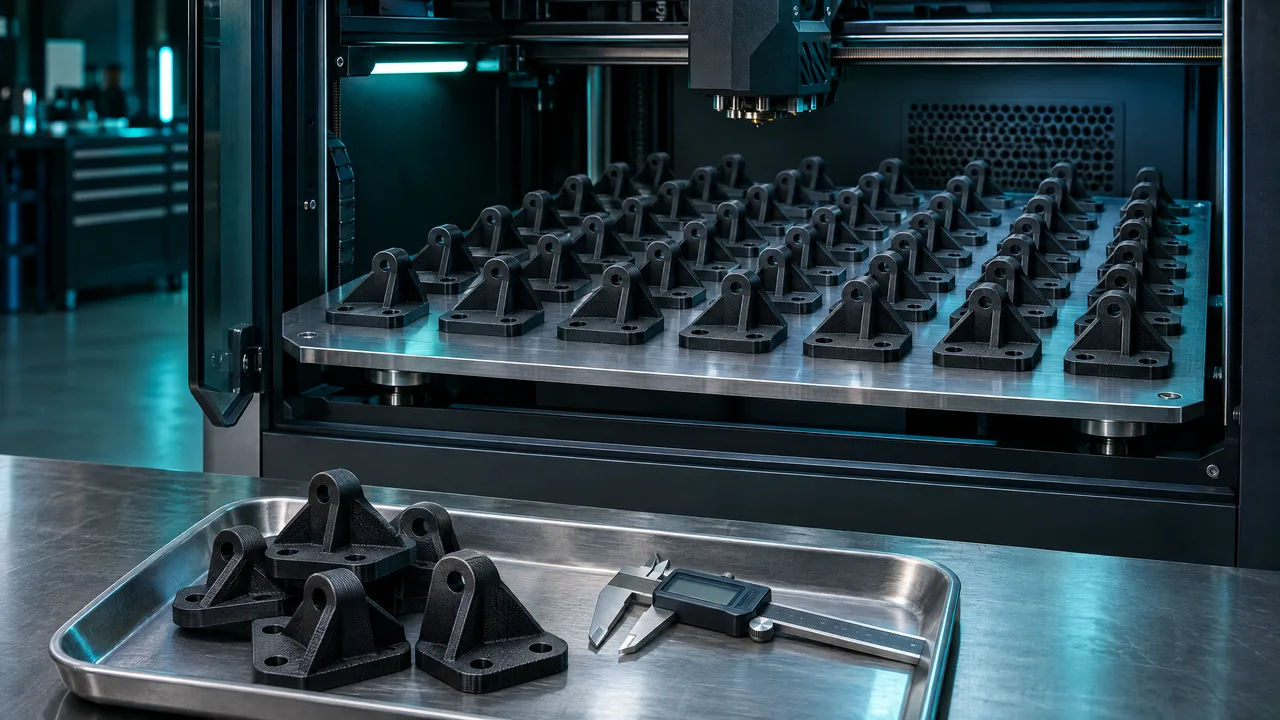
- Dimensional check with a digital caliper before shipping
Suitable materials
Selected for the application on the machine. All values according to the manufacturer datasheet – details in the material database.
iglidur I180
For sliding blocks, bushings and guides without lubrication. No food contact according to the safety data sheet.
- Heat deflection
- 180 °C continuous operation
- Strength
- ~65 MPa
PA6-GF
For brackets and housing parts with vibration and mechanical load.
- Heat deflection
- ~182 °C (HDT/A)
- Strength
- ~120 MPa (ISO 527)
PPS-CF
For parts in contact with oil, grease, acids, alkalis or solvents – resistant according to the manufacturer datasheet, 0.05 % water absorption.
- Heat deflection
- 264 °C (HDT/B, 0.45 MPa) / 235 °C (HDT/A, 1.8 MPa)
- Strength
- 87 ± 5 MPa (X-Y, ISO 527)
Prusament ASA
For outdoor covers and housings: UV and weather resistant according to the manufacturer datasheet.
- Heat deflection
- ~98–104 °C (HDT/A)
- Strength
- ~47 MPa (ISO 527)
TPU Air
For dampers, buffers and seals. Not a load-bearing part.
- Heat deflection
- Vicat 53–83 °C depending on foaming level (ISO 306)
- Strength
- 3.8–10.3 MPa tensile strength at break (X-Y, ISO 527)
- Hardness
- Shore 63–85A
Values according to the manufacturer’s datasheet, measured in the printing plane (X-Y).
Limits of FFF
FFF is not the right process for every part. These points are checked before we quote:
- Tolerances: typically ±0.2 mm; general tolerances to DIN ISO 2768-m; tighter tolerances on functional surfaces by arrangement, possibly with post-machining.
- Parts are built in layers. Strength across the layers (Z) is lower than in the printing plane – we orient the part according to the main load direction.
- Gears and rollers under high load or speed are assessed case by case – not every original can be replaced equivalently by an FFF part.
- For safety-relevant parts, for example on guards, approval lies with the operator.
- The original material is often unknown or not available as FFF filament. We choose a material based on application and environment.
- Part size up to 500 × 500 × 500 mm, depending on the material.
From enquiry to delivered part
- 01
Enquiry
Upload STEP or STL via the calculator or send a drawing, photo or sample part description via the contact form. NDA on request before you send any data.
- 02
Design review
Every part is reviewed before production: wall thicknesses, print orientation according to the main load direction, material choice.
- 03
Quote
The calculator gives an indicative price; the binding quote follows the design review.
- 04
Production
Filament is dried before every print and stored under vacuum. For small batches and repeat orders the print parameters are documented. Express 2–3 working days, standard 5–7 working days.
- 05
Dimensional check
Dimensions are checked with a digital caliper before shipping.
- 06
Shipping
Shipped from Stuttgart – single parts or small batches of up to 500 pieces.
Frequently asked questions
Is it worth producing a single spare part?
FFF printing needs no tooling and has no minimum batch size – a single part is just as possible as a small batch of up to 500 pieces. The online calculator shows an indicative price for your part after you upload the file.
I have no CAD, only the old part. What now?
Then the sample part is measured or digitised by 3D scanning and redesigned in CAD. How this works is described on the page about reproduction via 3D scan.
Which material is suitable for sliding parts and bushings?
For sliding applications without lubrication we use iglidur I180 – self-lubricating and rated for 180 °C continuous operation according to the igus datasheet. According to the safety data sheet it is not intended for food contact.
Can I reorder the same part later?
Yes. For small batches and repeat orders the print parameters are documented so that the reordered part is produced with the same settings.
How quickly will the spare part arrive?
After the design review and approval: express 2–3 working days, standard 5–7 working days. If the part first has to be digitised and redesigned, that effort comes on top.
Have your part checked
Upload STEP or STL for an indicative price, or send a drawing, photo or description. Binding quote after the design review.