
Technical Specifications
Typical Applications
- Anti-slip pads and rests on machinery
- Ergonomic hand grips for tools and fixtures
- Soft profile gaskets for uneven surfaces
- Protective caps and grommets with high elongation
- Damping interlayers at low surface pressure
Material Documents
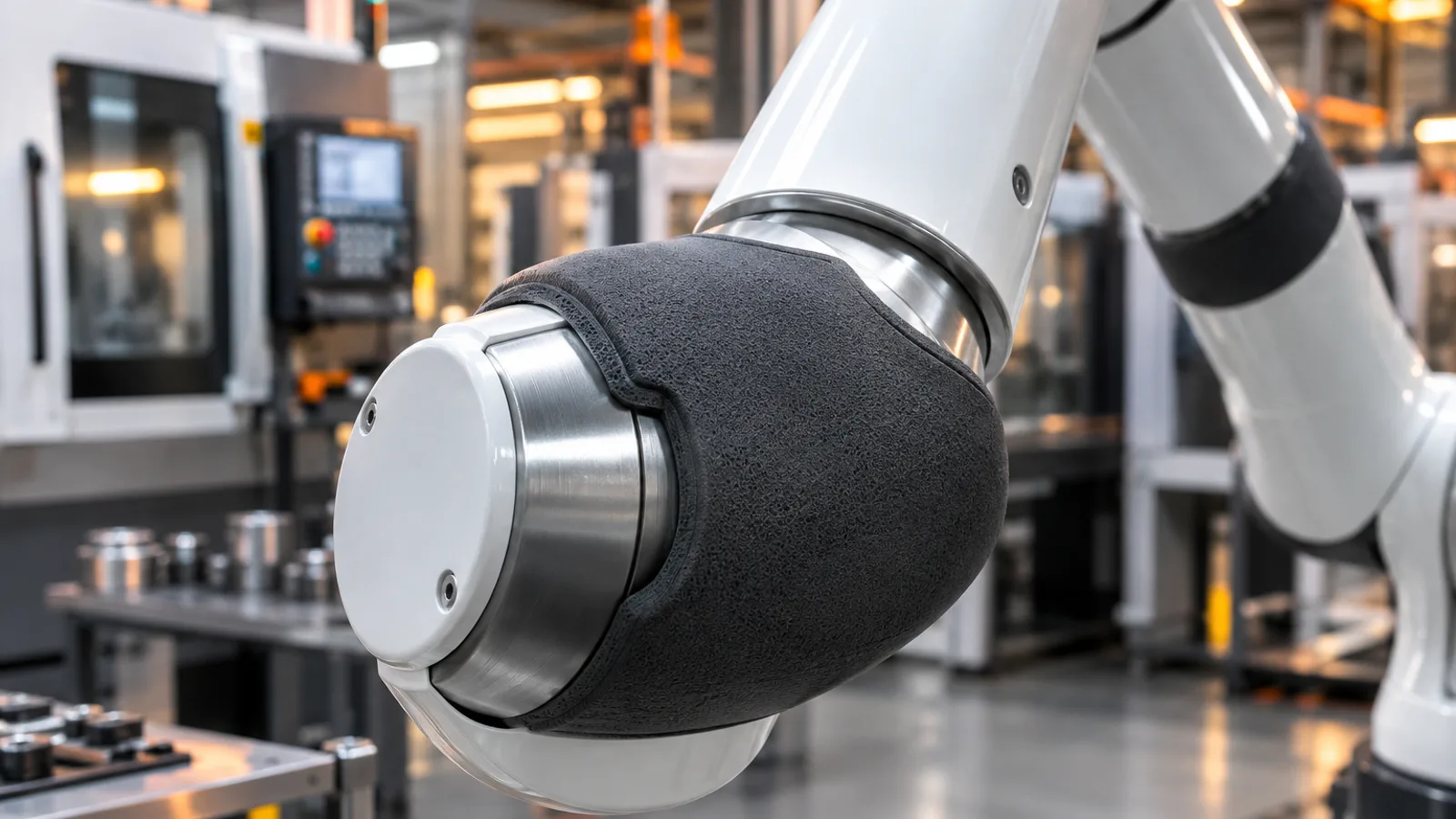
Material profile
Below Shore 85A the classic TPU programme ends. If you need a part you can press in with your hand, that conforms to an uneven surface, or that feels warm and yielding as a grip, you end up with the very soft thermoplastic elastomers: TPE and TPR.
Important for the design: “TPE” is not a material specification but a product group. Behind the acronym sit copolyester elastomers, styrene block copolymers, polyolefin compounds and often enough polyurethane as well. For many filaments the base is stated only in the safety data sheet – the product page frequently omits it or contradicts it. We therefore work with two materials whose figures and composition are documented, and we state in the project which one is used.
Documented figures
| Property | Shore 75A | Shore 81A | Standard |
|---|---|---|---|
| Hardness | 75 Shore A | 81 Shore A / 30 Shore D | ASTM D2240 |
| Tensile strength at break | 22 MPa | 22 MPa | ASTM D638 |
| Yield | 5 MPa | 1 MPa at 5 % elongation | ASTM D638 |
| Elongation at break | 600 % | 870 % | ASTM D638 |
| Tensile modulus | 34 MPa | not documented | ASTM D638 |
| Density | 1.13 g/cm³ | 1.07 g/cm³ | ASTM D792 |
| Melting temperature | 180 °C | 174 °C | DSC / ASTM D3418 |
| Glass transition | −80 °C | not documented | DSC |
| Moisture absorption, 24 h | 0.8 % | not documented | ASTM D570 |
These are material figures, not part figures: none of the datasheets states whether printed or injection-moulded specimens were tested, and none names a print direction. On FFF parts the Z strength is systematically lower.
Chemical resistance
For the Shore 75A material there is a manufacturer overview of 23 media in three ratings – without a test method and without exposure time, so it is to be read as a manufacturer statement:
- Resistant: water, acetic acid 10 %, hydrochloric acid 10 %, nitric acid 10 %, phosphoric acid 10 %, sodium hydroxide 10 %, zinc chloride 10 %, toluene, acetone, diesel (also at 85 °C)
- Limited resistance: ethanol, diethyl ether, ethyl acetate, ammonia solution 10 %, calcium chloride 10 %, hydrogen peroxide 30 %, sulfuric acid 30 %, tetrachloroethylene
- Not recommended: brake fluid DOT 3/4, chloroform, transformer oil, trichloroethylene
For parts in permanent contact with oil or hydraulic fluid, TPU is the better documented material.
Where it fits in the elastomer range
| Requirement | Material |
|---|---|
| Softest surface, grips, anti-slip | TPE / TPR, Shore 75–81A |
| Gaskets and dampers in oil contact | TPU 85A to 98A |
| Very high elongation, cold, low weight | PEBA |
| Damping at low weight, wipeable skin | Foamed TPU |
Design notes
- Limit surface pressure. At Shore 75A deformation starts early: 1 MPa of stress already produces 5 % elongation. For load-bearing rests that is too soft.
- Do not make sealing lips too thin. Very soft materials tend to fold over rather than seal. We set lip height and compression travel from the case.
- Accept the slow pace. Top and bottom layers at 10 to 20 mm/s. Soft elastomers need time, and that goes into the lead time.
- Do not assume a thermal rating. With no HDT or Vicat figure there is no defensible service temperature; only the melting temperature of 174 to 180 °C is documented.
What is not documented
A number of claims circulate around soft elastomers that are backed by a test standard in no manufacturer datasheet we checked: coefficient of friction and slip resistance, rebound resilience, abrasion resistance for these two materials, and any blanket statement that TPE is chemically more or less resistant than TPU. The marketing name does not always hold either: a filament sold as “60A” is measured at 63 Shore A in its own datasheet, a “30D” at 81 Shore A. We therefore always quote the tested value together with its standard.