
Technical Specifications
Typical Applications
- High-stiffness structural parts and load-bearing brackets as a metal/aluminium alternative
- Jigs & fixtures with high dimensional accuracy
- Functional parts in humid or warm environments (up to ~180 °C)
- Heavily loaded machine and automotive spare parts
Compliance Evidence
Free of hazardous substances (lead, mercury, cadmium, hexavalent chromium, PBB, PBDE) per EU Directive 2011/65/EU. Safe for commercial use in the EU.
Evidence: RoHS compliant – XRF test report per IEC 62321 (2011/65/EU + (EU) 2015/863), result "COMPLIES".
The evidence listed applies to the filament or raw material per manufacturer documentation. Regulatory clearance of the printed final product – particularly for food contact, medical devices, electrical applications or UL-relevant parts – is not automatically included and must be evaluated on a project-specific basis. Technical machine assignment is handled internally.
Material Documents
Material profile
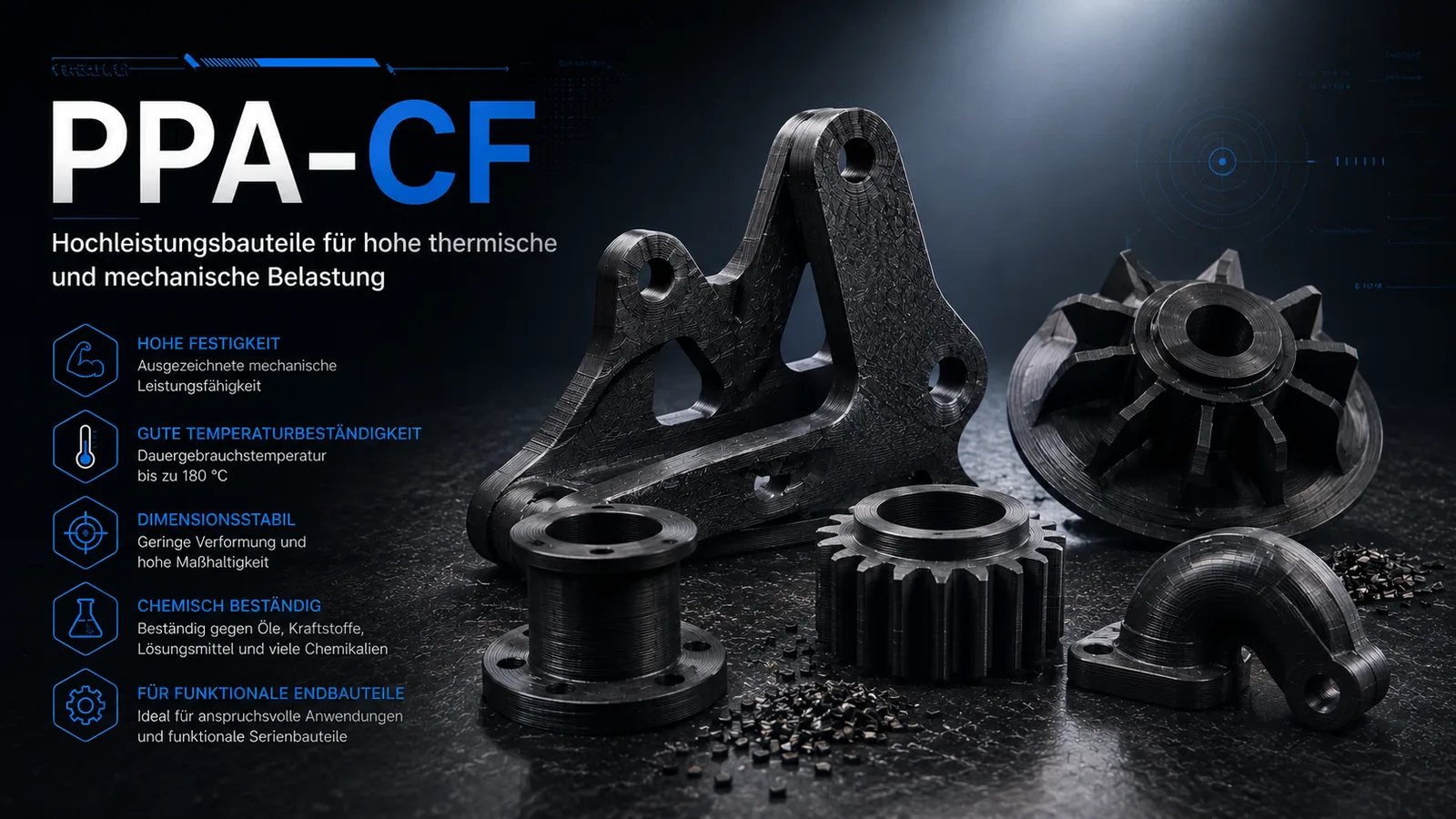
PPA (polyphthalamide) is a semi-aromatic polyamide – the aromatic rings in the polymer chain give it markedly higher heat deflection and stiffness than aliphatic polyamides (PA6, PA12). Combined with short carbon fibers, PPA-CF is the stiffest engineering material in our FFF portfolio: a flexural modulus of 9,860 MPa gives parts near-metal rigidity at just 1.25 g/cm³.
Documented values (manufacturer data sheet, TDS V1.0)
| Property | Value (X-Y) | Test standard |
|---|---|---|
| Tensile strength | 168 ± 4 MPa | ISO 527 |
| Tensile modulus | 11,800 ± 670 MPa | ISO 527 |
| Flexural strength | 208 ± 6 MPa | ISO 178 |
| Flexural modulus | 9,860 ± 480 MPa | ISO 178 |
| Impact strength (Charpy unnotched) | 41.7 ± 2.8 kJ/m² | ISO 179 |
| Heat deflection | 227 °C (0.45 MPa) / 196 °C (1.8 MPa) | ISO 75 |
| Vicat softening | 232 °C | ISO 306 |
| Water absorption (saturated) | 1.30 % | 25 °C, 55 % RH |
| Density | 1.25 g/cm³ | ISO 1183 |
In the Z direction tensile strength drops to 57 MPa (~34 % of the X-Y value); orient critical parts so the main load lies in the X-Y plane.
When is PPA-CF the right choice?
PPA-CF is the first choice when maximum stiffness and strength at low weight are required and the service temperature stays up to about 180 °C – without flame-retardancy or strong chemical exposure. For flame retardancy, chemical/fuel contact or continuous temperatures above 200 °C, choose PPS-CF instead.
Processing
PPA-CF is abrasive and moisture-sensitive: a hardened nozzle, pre-drying (100–140 °C, 8–12 h) and an enclosed, heated print system are required. Annealing (120–140 °C, 6–12 h) increases strength and Z adhesion but may cause warping – we set it project-specifically.