
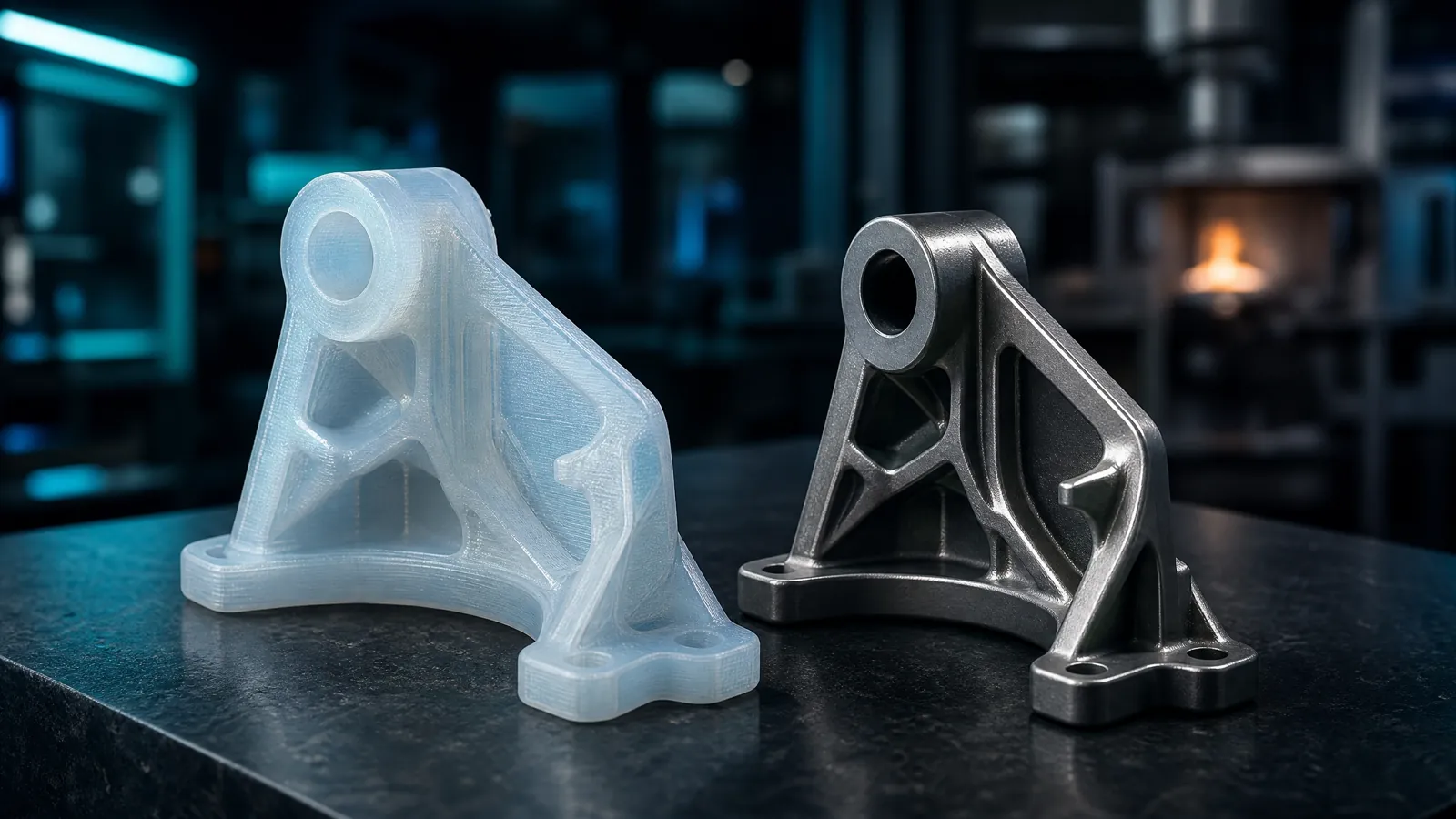
Investment casting patterns from the 3D printer
The wax pattern comes out of an injection mould – and that mould costs tooling before the first part exists. We print the master pattern straight from your CAD data instead: burnout with less than 0.003 % ash residue, from a quantity of one, with no tooling cost.
The tooling costs more than the batch
In conventional investment casting the wax pattern is produced in an injection mould. Its cost is incurred regardless of quantity – for a one-off, a spare part with no drawing, or a run of twenty pieces it is entirely out of proportion to the job. Add to that the lead time: weeks pass before the first wax pattern exists.
A printed master pattern skips that step completely. It goes straight from the CAD file into the printer, is available the same or the next day – and a geometry change costs a new file instead of new tooling.
The rest of the process stays exactly as it is: invest, burn out, pour. Your established foundry practice does not have to change, only the source of the pattern does.
From CAD model to casting
Five steps – we handle the first two, the last three stay in your foundry.
- 3D Fabrikant
Print
PolyCast master pattern straight from your CAD data – no tooling, from a quantity of one.
- 3D Fabrikant
Smooth
Optional: isopropyl alcohol softens the surface, layer lines disappear. Sprues can be bonded on at this stage.
- Your foundry
Invest
Pattern is invested in a ceramic shell or investment plaster.
- Your foundry
Burnout
Kiln at 1,100–1,200 °C: the shell sinters, the pattern burns out with minimal residue.
- Your foundry
Pour
Metal fills the resulting cavity. Rinse the shell afterwards.
Where a printed master pattern pays off
Foundries & investment casters
Buy in patterns without committing to tooling: you receive ready-to-invest master patterns for jobs where a wax injection mould does not pay off – sample castings, replicas and small batches. Your burnout schedule and investment material stay unchanged.
Typical: single castings and runs up to medium volumeEngineering: metal parts & spares
A metal component in a quantity of one – no minimum order, no tooling cost. Particularly suited to spare parts of which only a sample or a 3D scan remains, and to functional prototypes that need to be tested in the target material.
Typical: spare part from a sample, prototype in the target metalJewellery, art & restoration
Classic lost-wax casting – just with a digital pattern. The surface can be smoothed with isopropyl alcohol so that layer lines disappear before investing. For one-off pieces, repeat parts and reconstructions from a reference.
Typical: unique pieces, production rings, replicasDental & medical technology
Model casting applications such as denture frameworks. The master pattern burns out with minimal residue and is no longer present in the finished casting – so the material approval of the end product is determined by the alloy, not by our pattern material.
No biocompatibility or MDR evidence – see the note belowNote on dental and medical applications: Polymaker states neither biocompatibility nor suitability as a medical device for PolyCast, and we do not infer any such suitability. We supply the burnout master pattern only. Material approval, biocompatibility and MDR conformity assessment for the finished casting rest with your dental laboratory or foundry.
What we supply – and what we don't
We handle this
- PolyCast master pattern printed from your CAD data
- Engineering review of the geometry before printing
- Layer orientation chosen against breakage risk in handling
- Optional surface smoothing with isopropyl alcohol
- Sprue printed in place or bonded on cohesively
- Dry storage until dispatch
This stays with you
- Investing in a ceramic shell or investment plaster
- Burnout and sintering of the shell
- Pouring and alloy selection
- Design of the gating system
- Shrinkage compensation
- Finishing and inspection of the casting
We do not operate a foundry. This page promotes the printed master pattern as a supplied component – so you know in advance where our service ends and yours begins.
PolyCast at a glance
Mechanical and thermal values from the Polymaker PolyCast V5.4 datasheet, the ash residue from Polymaker's product information. Base polymer: PVB, formulated for burnout.
| Property | Value | Test method |
|---|---|---|
| Ash residue after burnout | < 0.003 % | Manufacturer (Ash-Free™) |
| Density | 1.10 g/cm³ | ISO 1183 |
| Tensile strength (X-Y) | 53.2 MPa | ISO 527 |
| Tensile strength (Z) | 26.3 MPa | ISO 527 |
| Glass transition temperature | 70 °C | DSC |
| Decomposition temperature | 260 °C | TGA |
| Heat deflection temperature (HDT/A) | 53 °C | ISO 75 |
| Equilibrium moisture | 2.09 % | 70% RH, 23 °C |
⚠ The ash residue figure is a manufacturer statement under laboratory conditions, not a test certificate for your kiln. Burnout schedule and residue must be validated per foundry, investment material and kiln type.
Common questions about printed casting patterns
What burnout schedule does a PolyCast pattern need?
Polymaker specifies 1,100–1,200 °C over 40–60 minutes for shell burnout – at that temperature the ceramic shell sinters while the pattern burns out. The ash residue below 0.003% is stated by the manufacturer without a measurement temperature or test standard. Important: this is a manufacturer statement, not a test certificate for your kiln. Ramp rate, hold time and result depend on your investment material, pattern wall thickness and kiln type – Polymaker explicitly notes that every foundry has to determine its own schedule. We therefore recommend dialling in the first run with a sample part. After cooling, the shell should be rinsed with water to flush out any remaining ash.
How dimensionally accurate is the pattern – and who accounts for shrinkage?
The printed pattern sits within normal FFF tolerances; we produce exactly to the dimensions in your CAD file. What matters, though, is the full shrinkage chain: print shrinkage, investment shrinkage and alloy shrinkage on solidification all add up – and only your foundry knows the last two, because they depend on the investment material and the metal. We therefore do not apply a shrinkage allowance on our own initiative. Either send us an already compensated model, or tell us the scaling factor you want – we apply it and document it in the order.
Which metals is the process suitable for?
That is not a question of the pattern but of your foundry: the PolyCast pattern burns out with minimal residue and is no longer present in the finished casting. In principle, therefore, all alloys common in investment casting are possible – bronze, brass, silver, gold, stainless steel, aluminium. The limits are set by your foundry's investment material and kiln technology, not by the pattern material.
Is there a minimum wall thickness for the pattern?
A pattern has to survive two loads the later casting never sees: handling and investing. Very delicate webs can float up or break during investing. As a guide value we work with roughly 0.8–1.0 mm minimum wall thickness on a 0.4 mm nozzle; finer structures are feasible, but we assess them upfront on your specific geometry. Since PolyCast reaches only about half its tensile strength in the Z direction (~26 instead of ~53 MPa), we deliberately avoid orienting thin webs vertically.
Do you design the gating system?
The gating system is a foundry decision – position, cross-section and feeder layout depend on alloy, casting process and tree layout. We print the sprue if it is part of your CAD file. Alternatively we bond gating channels afterwards: PolyCast can be softened with isopropyl alcohol and joined cohesively, without introducing any foreign material into the cavity.
How should the patterns be stored and shipped?
Two points are critical. First moisture: PolyCast absorbs up to 2.09% water – we therefore print from dry-stored material and ship the patterns packaged. Second heat: at around 53 °C heat deflection temperature a pattern will already distort in a hot vehicle or a sunlit storeroom, and any distortion transfers one-to-one into the casting. Patterns should be kept cool and invested promptly.
More questions → Full FAQ page
Calculate a pattern or discuss your project
Upload an STL or STEP file, select PolyCast – price and lead time appear in under a minute. For complex geometries we review feasibility with you first.