
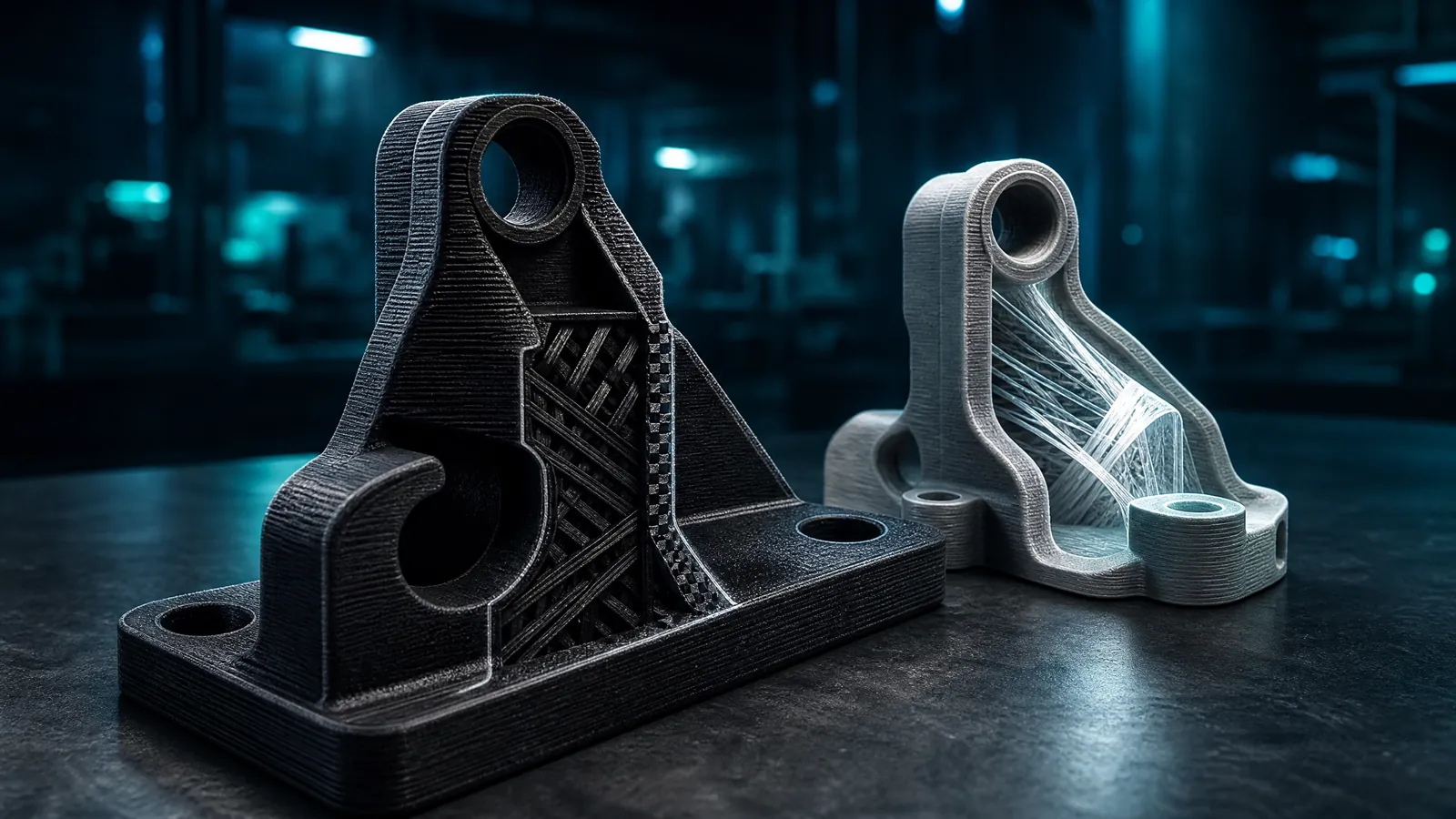
Fiber-Reinforced 3D Printed Parts: Carbon & Glass Fiber
Stiffness at aluminum level, at a fraction of the weight and cost – manufactured in 2–3 business days.
The fixture is needed – not in six weeks
Every manufacturing manager knows the scenario: a gripper for the new robot cell, an assembly fixture, a test gauge – designing the part is quick, but the machined aluminum equivalent costs several hundred euros depending on complexity, weighs more than necessary, and takes weeks to arrive from a busy contract manufacturer. For quantities from 1 to small batches, this effort is often disproportionate to the part.
Fiber-reinforced FFF printing closes exactly this gap: short carbon or glass fibers in the thermoplastic bring stiffness and dimensional accuracy to a level that's fully sufficient for most fixture, gripper and bracket applications – at 50–70% less mass, with no tooling cost and delivery in 2–3 business days. We're just as clear about where the limits are – this page helps with the decision.
Understood in a few minutes
Two compact videos show what carbon- and glass-fiber-reinforced parts can do – and how to choose the right material for your use case. The videos only load when played.
Carbon-Fiber-Reinforced Parts (CF)
How CF parts are manufactured, what stiffness and temperature resistance they achieve, and when they replace machined aluminum parts. With real-world examples from gripper and fixture construction.
Glass-Fiber-Reinforced Parts (GF)
When GF is the more economical choice: electrical insulation, impact resistance and chemical resistance at a glance. Including a comparison to CF using typical use cases.
CF or GF – which fiber for which application?
Maximum stiffness per gram
- Highest stiffness relative to mass – ideal for moving parts
- Heat deflection up to ~240 °C (PPA-CF)
- Vibration-damping – calmer processes on dynamic axes
- Electrically conductive (10³–10⁵ Ω) – ESD-relevant, note near electrical equipment
- Premium price segment
Typical: Robot grippers, moving axes, lightweight structures.
Economical and electrically insulating
- More economical than CF while remaining highly stiff
- Electrically insulating (> 10¹² Ω) – important near electrical equipment
- More impact-resistant and forgiving under shock loads
- Chemically resistant – PP-GF against acids, bases, solvents
- First choice for static applications
Typical: Static fixtures, brackets, lab environments.
Not sure? Material consulting is included in every inquiry – we recommend the fiber for the load case, not the price.
Request consulting →Where fiber-reinforced parts pay off
Robot Grippers & End Effectors
Every gram less on the gripper means a faster cycle time or more payload at the robot flange. CF parts significantly reduce moving mass without compromising on stiffness.
Recommendation: PA-CFFixtures & Gauge Building
Clamping fixtures, assembly aids and test gauges need above all dimensional accuracy and low warping. Fiber reinforcement significantly reduces shrinkage – parts stay shape-stable over their service life.
Recommendation: PA-CF / PA-GFPPA-CF and PPS-CF compared directly
Two carbon-reinforced high-performance materials with documented manufacturer data: PPA-CF for near-metal stiffness (168 MPa, flexural modulus 9,860 MPa), PPS-CF for chemical, heat and moisture resistance (264 °C, 0.05 % water absorption).
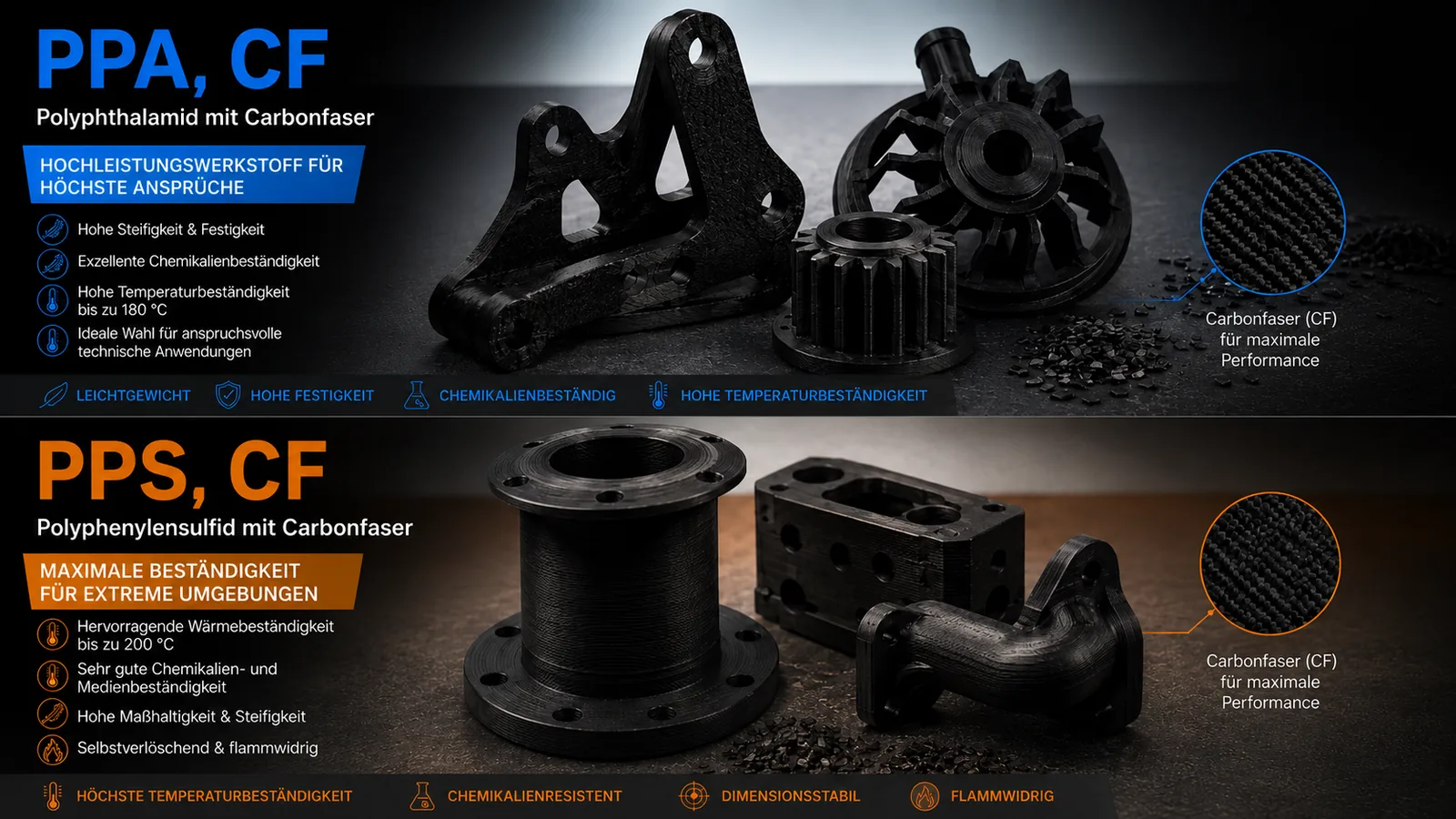
PPA-CF & PPS-CF in 3D printing
Product presentation of the two carbon-reinforced high-performance materials: PPA-CF for near-metal stiffness, PPS-CF for chemical, heat and moisture resistance. The video loads only on play.
All CF and GF materials at a glance
Reference values from manufacturer datasheets. HDT per ISO 75 / HDT/A, tensile strength per ISO 527 (in layer direction).
| Material | HDT | Tensile Strength | Notable For | Datasheet |
|---|---|---|---|---|
| PA-CF | ~180 °C | ~100 MPa | Load-bearing structural parts | → Sheet |
| PAHT-CF | ~200 °C | ~120 MPa | Engine bay, oven environments | → Sheet |
| PPA-CF | ~227 °C | ~168 MPa | Highest stiffness (near-metal) | → Sheet |
| PPS-CF | ~264 °C | ~87 MPa | Chemical, heat, flame-retardant | → Sheet |
| PC-CF | ~145 °C | ~75 MPa | Rigid structural parts | → Sheet |
| PETG-CF | ~80 °C | ~60 MPa | Easier than PA-CF | → Sheet |
| PET-CF | ~100 °C | ~70 MPa | Dimensionally accurate, chem. resistant | → Sheet |
| PA-GF | ~120 °C | ~80 MPa | Electrically non-conductive | → Sheet |
| PP-GF | ~110 °C | ~50 MPa | Acids, bases, alkalis | → Sheet |
⚠ Fiber-reinforced FFF parts are anisotropic: the stated tensile strength applies in the layer direction. We design the layer orientation according to the part's main load direction – more on this under Part Optimization.
Use this material in the calculator → Go to the material catalog →
Frequently Asked Questions About Fiber-Reinforced Parts
Do carbon-fiber-reinforced 3D printed parts replace machined aluminum parts?
In many cases, yes – but not universally. For stiffness-driven applications (fixtures, grippers, brackets) and quantities of 1 to ~100, PA-CF or PC-CF achieve the necessary structural stiffness at 50–70% less mass and a fraction of the manufacturing cost – with no machining effort and in 2–3 business days. Replacement isn't suitable for continuous operating temperatures above the material's HDT (PA-CF: ~180 °C, PPA-CF: ~227 °C, PPS-CF: ~264 °C), for applications requiring high ductility (plastics fail more brittle than aluminum), or for very tight tolerances under continuous load (creep behavior). We assess this honestly as part of every inquiry – even when the result is: aluminum remains the better choice.
What does a fiber-reinforced 3D printed part cost?
The price depends on part volume, material choice (GF materials are more economical than CF, PPA-CF is premium), infill density, quantity and lead time. Typical fixture parts come in well below the cost of a machined aluminum equivalent. Calculate the exact price yourself: upload an STL or STEP file to the online calculator, choose a material – the quote is ready in under a minute.
Are CF parts electrically conductive?
Yes. The short carbon fibers make CF filaments electrically conductive – surface resistance is typically 10³–10⁵ Ω. This is uncritical for structural parts, but must be considered near electrical equipment, high-voltage systems, or in ESD-sensitive environments. The insulating alternative with similar stiffness: glass-fiber-reinforced materials like PA-GF with a surface resistance > 10¹² Ω.
How load-bearing are fiber-reinforced parts perpendicular to the print layer?
FFF-printed parts are anisotropic: strength perpendicular to the layer plane (Z direction) is, depending on material, roughly 40–70% of the strength in the layer direction, because layer adhesion carries the load there instead of the fiber reinforcement. This isn't a disqualifying factor but a design question: we orient the print direction to the part's main load direction, design wall thicknesses and fillets accordingly, and discuss critical load cases before manufacturing. This design expertise is part of every order.
More questions → Full FAQ page
Calculate a part or get consulting
Upload an STL or STEP file, choose CF or GF material – price and lead time are ready in under a minute. Material consulting from a mechanical engineering technician included.